Designing a Better Support System for Unemployment
Organization
Civilla
Client
Michigan Unemployment Insurance Agency
Timeline
December 2024 - May 2025
Role
Design Lead, Research, Service Design & Strategy
What if the people already helping residents navigate unemployment were better connected to the agency behind it?
Across Michigan, community organizations were already helping people understand unemployment, troubleshoot claims, and get unstuck. I led research, service design, and strategy to help UIA turn that informal network into a model for a statewide Community Navigator Program.
Mandate
Define how UIA could work with community organizations to give residents more consistent, trusted unemployment support.
Contribution
Research Strategy · Service Design · Co-Design · Systems Thinking · Program Strategy · Implementation Planning
Outcome
3 partner levels → 1 statewide service model → phased implementation plan
THE SITUATION
People were already getting help. The experience depended on where they went.
Losing a job is stressful enough. Then you're expected to understand eligibility rules, identity verification, online accounts, paperwork, deadlines, and unfamiliar government language.
So people turn to organizations they already trust.
Libraries, workforce organizations, nonprofits, and advocacy groups across Michigan were already helping residents access unemployment services. But their roles, expertise, and relationships with UIA varied widely.
A claimant might find someone who could help resolve a complicated issue, or someone who could only point them back to the website.
The support network already existed. It just wasn't designed as a network.

WHAT I WALKED INTO
The problem wasn't a lack of support. It was the system around it.
A Navigator Program couldn't only work for claimants. It also had to work for the community organizations delivering support and the UIA staff responsible for maintaining those relationships.
That created three connected needs:
Claimants needed somewhere they trusted to get help.
Community partners needed training, clear boundaries, and someone to call when they couldn't solve a problem.
UIA needed a program it could realistically staff, manage, and sustain statewide.
Improving one part meant understanding what the other two needed to make it possible.
We needed to understand what support already existed before designing something new.
We researched how community organizations were already helping claimants, where they felt confident, where they got stuck, and what happened when a problem went beyond their expertise. One finding changed how we framed the entire project.
We started by asking: How do we give community organizations better information?
Research pushed us toward a different question: How do we create a better relationship between UIA and the organizations already helping claimants?
Partners didn't simply need another toolkit. They needed clear roles, different levels of training and support, and a reliable path back to UIA when someone had a problem they couldn't solve.
We weren't designing better resources anymore. We were designing a partnership.

Our hunch
We thought partners needed better information. They needed a better relationship.
What does a community organization actually need to help someone navigate unemployment?
We started by looking at what community organizations needed to better support people applying for unemployment. Research changed the question. The biggest gaps weren’t just in information or training, but in how partners and UIA communicated, collaborated, and understood each other.
Research plan
We started by looking at the support already happening outside UIA.
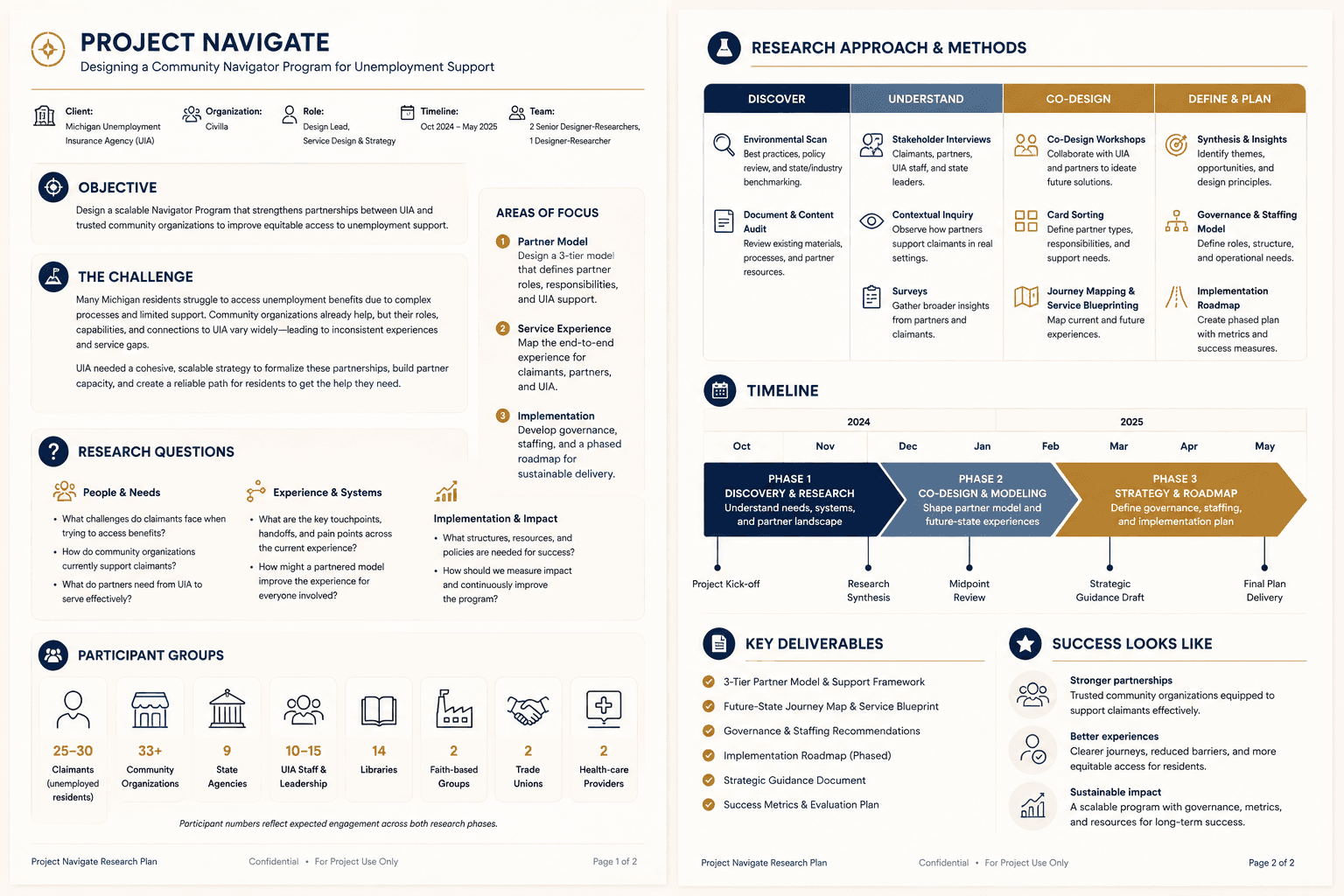
We designed a mixed-method research approach to understand how community organizations were helping claimants today, where support was breaking down, and what partners needed to help more effectively. Through interviews, surveys, and collaborative research activities, we gathered perspectives across organizations with different levels of experience, capacity, and connection to UIA, giving us both the depth to understand individual experiences and the breadth to identify patterns across the partner network.
Discovery
Partners were already doing Navigator work. But their experiences varied widely.
Through 16 discovery interviews and 75 survey responses, we learned how community organizations were supporting claimants, from answering questions and interpreting notices to troubleshooting more complex issues. Together, the interviews and survey revealed meaningful differences in partners’ knowledge, capacity, confidence, and connection to UIA.


Affinity mapping
The same frustrations kept showing up.
As we synthesized the interviews, patterns clustered around more than knowledge gaps: unclear roles, inconsistent communication, limited visibility into UIA, and uncertainty about where a partner’s responsibility should end.

Insights
Better training alone wasn’t going to solve the problem.
Partners needed information, but they also needed clearer expectations, stronger communication channels, and a relationship with UIA they could rely on when a claimant’s situation became more complicated.

Reframing
So we changed what we were designing.
Rather than treating the Navigator Program as a one-time training program, we reframed it as an ongoing partnership between UIA and organizations already trusted by their communities.
We entered research focused on resources and training. We left understanding that the bigger opportunity was strengthening the relationship between UIA and community organizations.
DEFINING THE SUPPORT SYSTEM
Designing the future with the people who would have to make it work
By the time we moved from research into design, the conditions around the program had changed.
Following the election, expected funding for the Navigator Program was no longer available. When Phase 2 began in January, we weren't designing a fully funded program and then figuring out how to scale it back. We were designing within that constraint from the start.
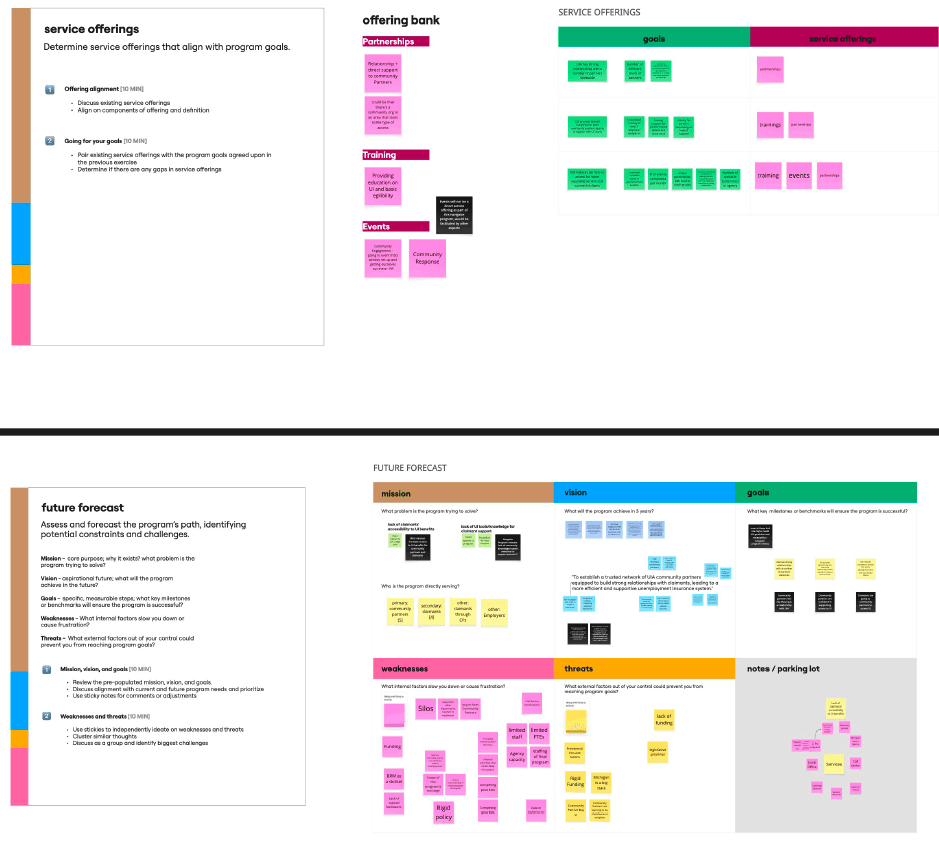
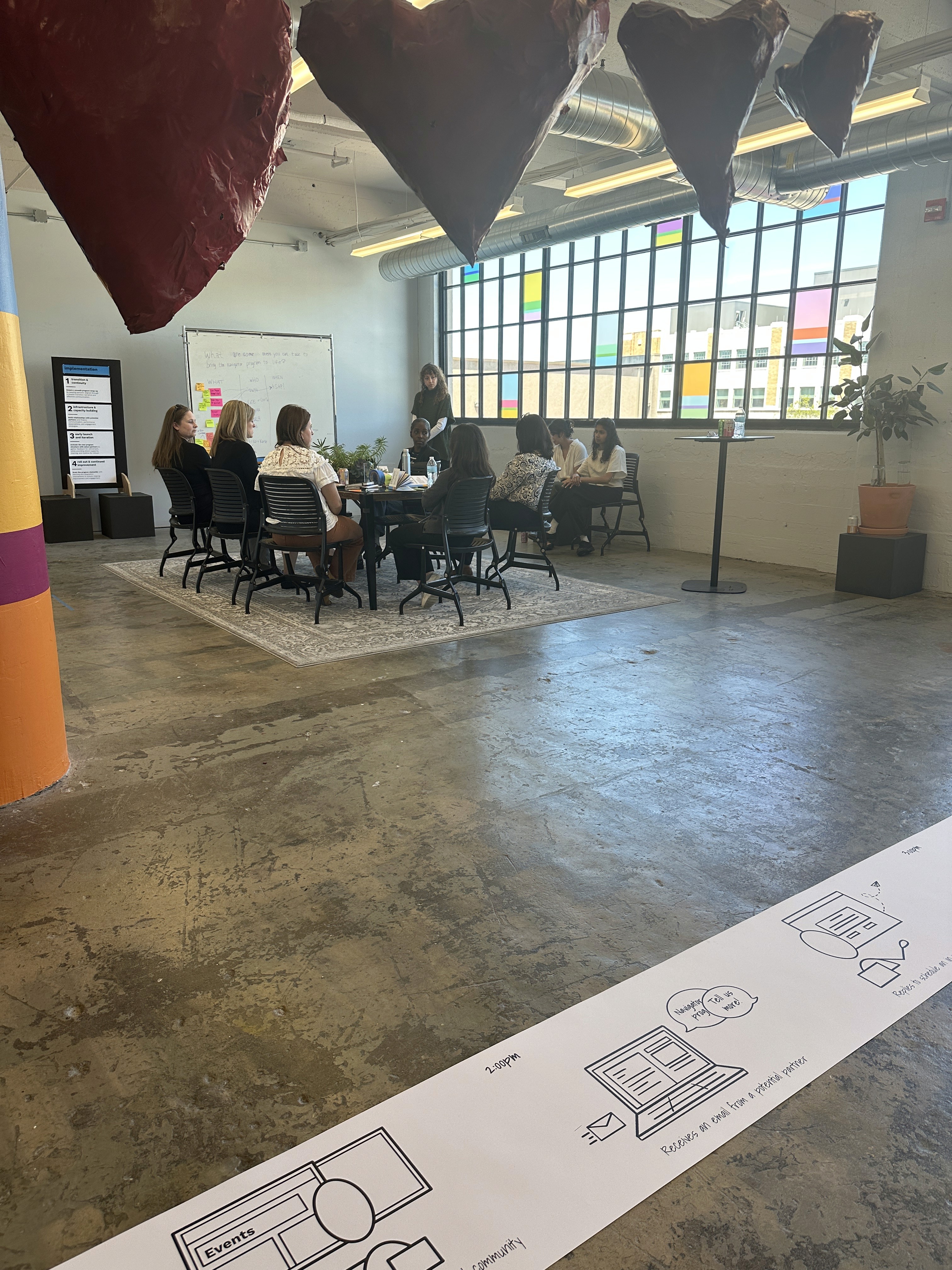
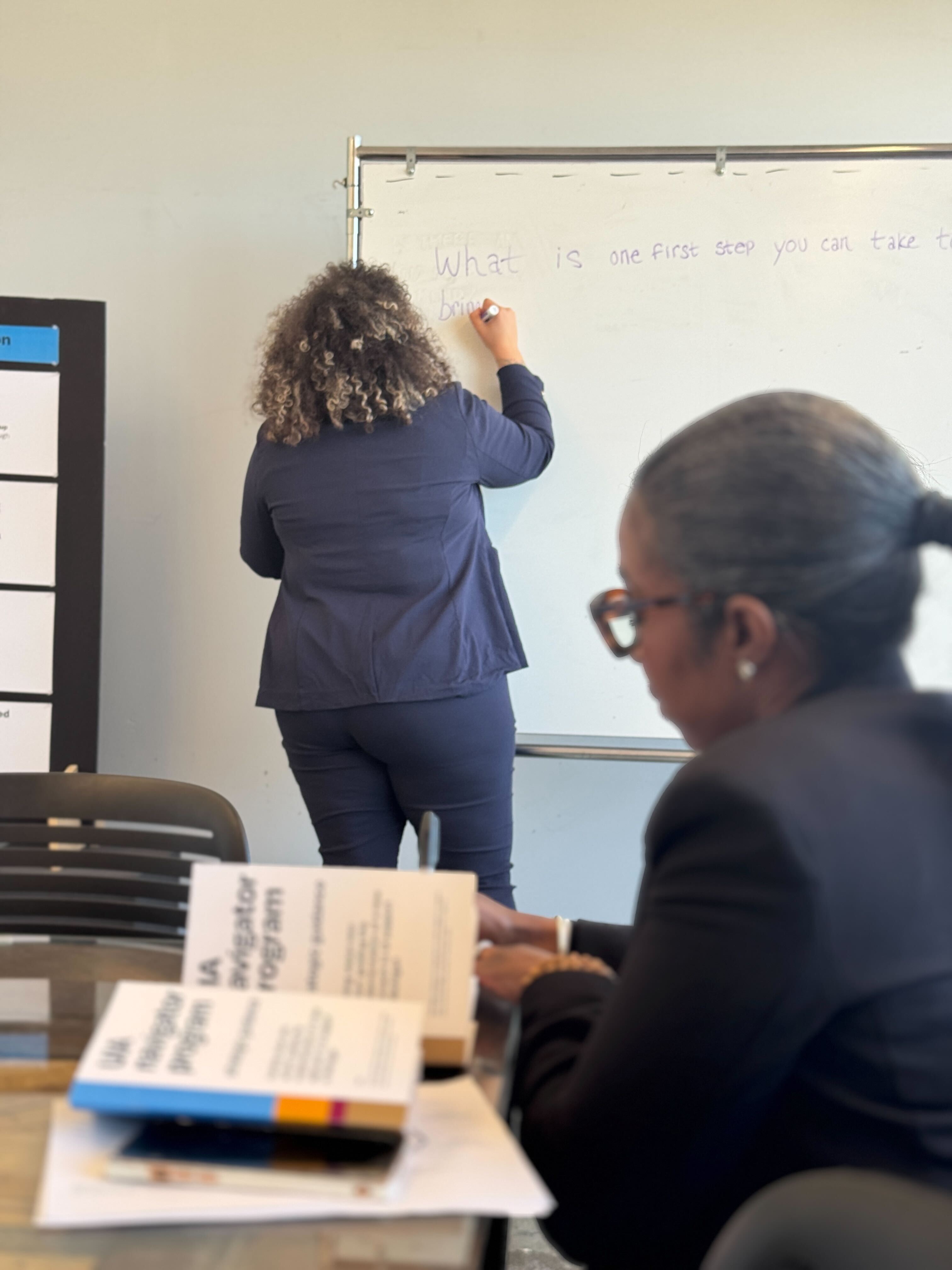
Our design process became a series of weekly facilitated working sessions with UIA leadership and subject matter experts. Rather than bringing the agency a finished recommendation, we used each session to work through a different part of the program together.
We used co-design, card sorting, prioritization, SWOT analysis, and future forecasting to explore questions like:
What kinds of organizations should participate?
What should partners actually be responsible for?
What support could UIA realistically provide?
What would need to happen inside the agency?
What could begin with existing resources?
What should the program grow into over time?
Each week built on the last, gradually turning the research into a program UIA could actually operate.
Suggested image: A horizontal January → May timeline with 4–6 actual facilitated sessions and small artifact thumbnails underneath. This should become the primary Design Process visual.
Different partners needed different ways to participate
One of the first things we had to resolve was what being a “Navigator” actually meant.
A library offering computers and internet access could play an important role without becoming an unemployment expert. An organization handling claims every day could provide deeper support, but needed a different relationship with UIA.
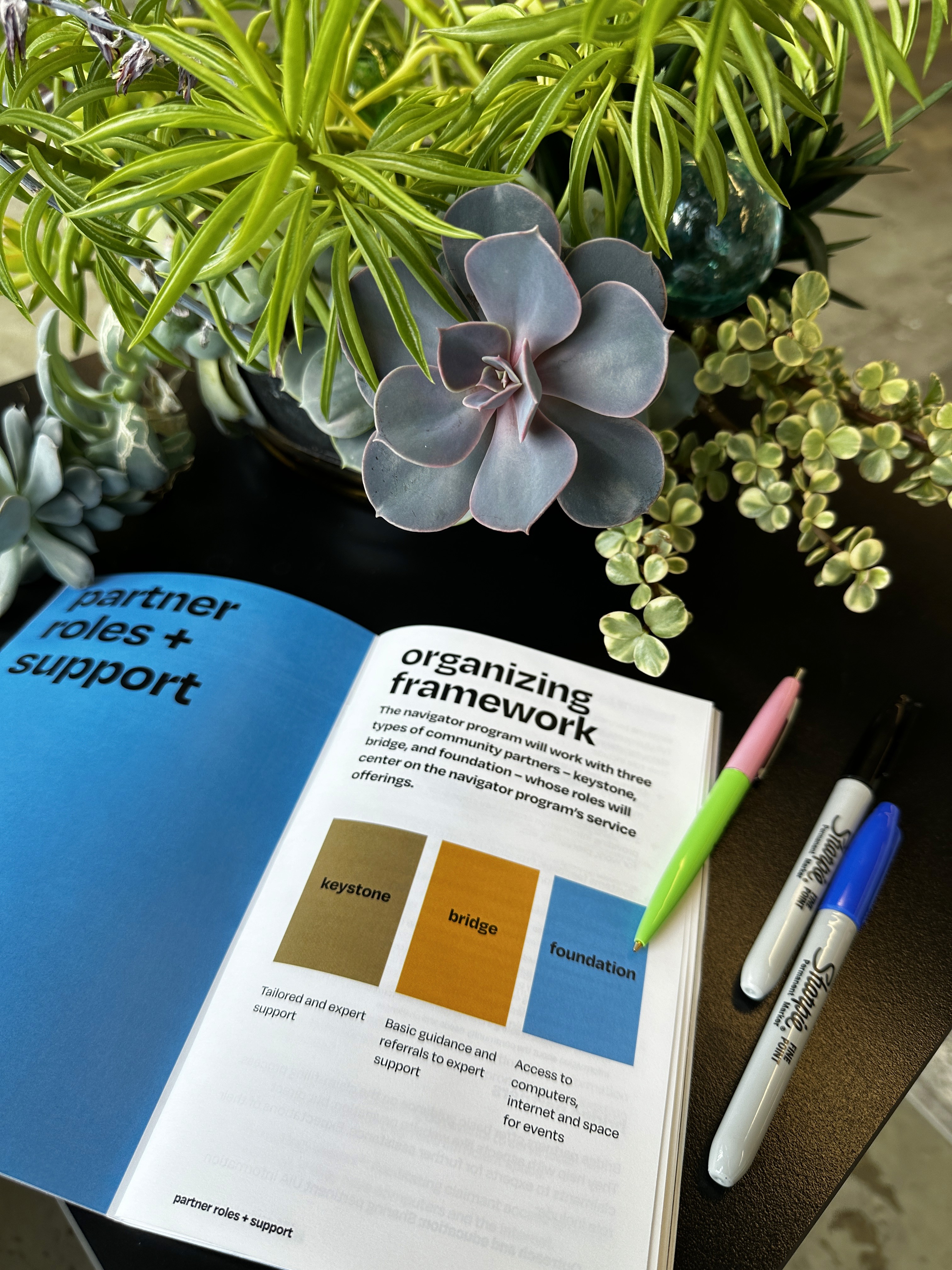
Through card sorting and facilitated discussion, we worked with UIA to organize responsibilities around three levels of participation:
FOUNDATION | BRIDGE | KEYSTONE |
|---|---|---|
Make support accessible. | Help people navigate. | Help people get unstuck. |
Provide access to technology, space, events, and unemployment resources. | Answer common questions, help people navigate the system, and connect them to the right next step. | Provide deeper claim support with a more direct relationship to UIA. |
The point wasn't to rank partners. It was to match responsibility with capacity.
Defining the partner model was only the beginning.
Every program decision created an operational decision
Week by week, we worked through recruitment, onboarding, training, claimant support, escalation, communication, measurement, and the ongoing relationship between partners and UIA.
The conversations quickly moved between experience and operations:
If a partner escalates an issue, who receives it?
If UIA offers ongoing training, who maintains it?
If partners have a direct relationship with the agency, who owns it?
We mapped those decisions into a future-state journey and used it to define the staffing, governance, infrastructure, and processes required behind the experience.

Building a path from today's constraints to tomorrow's program
Because funding was constrained from the beginning of Phase 2, implementation couldn't depend on building everything at once.
Our weekly sessions helped distinguish between what UIA could begin with existing resources, what required additional capacity, and what could be developed over time.
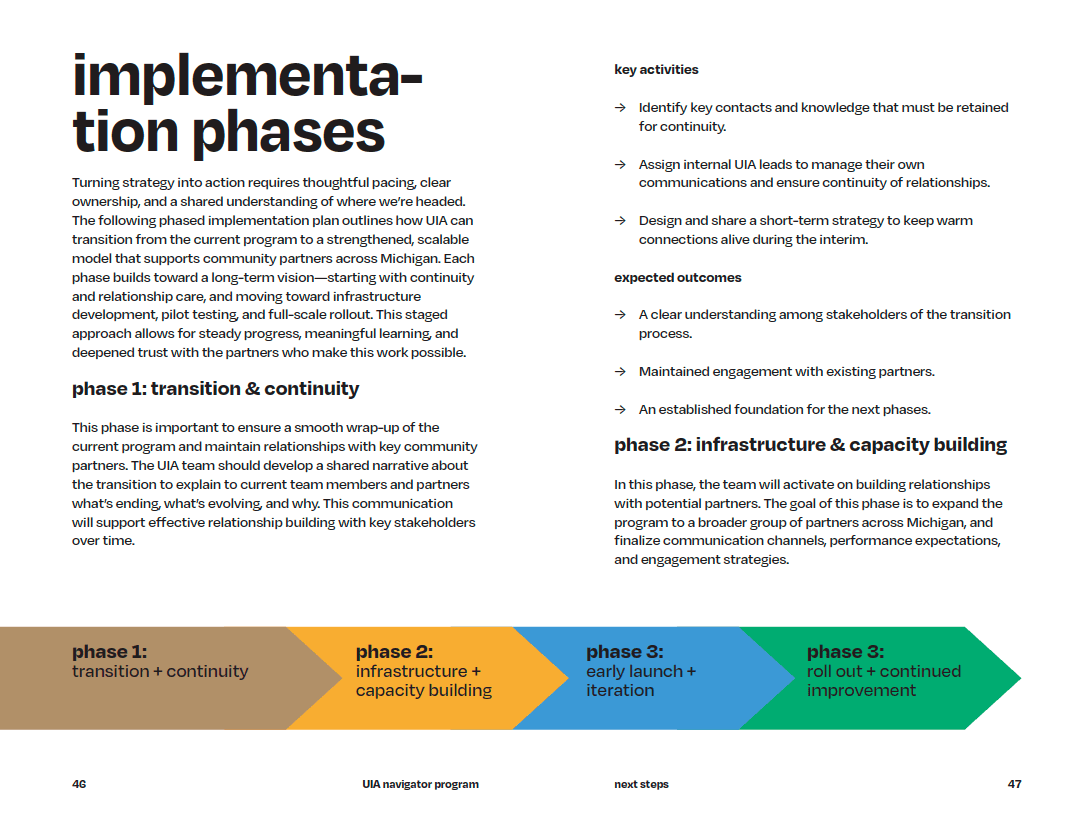
That became a phased strategy for Transition & Continuity, Infrastructure & Capacity, and Pilot & Iteration, preserving the larger vision while giving UIA a realistic place to start.
The final Strategic Guidance brought those decisions together into a blueprint for the program's structure, management, and implementation.
Service Design
Every frontstage promise creates backstage work.
How do you design a new service when the organization has to deliver it with limited capacity?
The weekly sessions weren't just about imagining a better partner experience. They gave UIA leaders and SMEs a place to work through what the agency would actually have to do to deliver it.
01 · Design the experience together
We worked through the program one part at a time.
Recruitment. Onboarding. Training. Claimant support. Escalation. Continued learning. Partner relationships.
Each facilitated session added another piece to the future experience.
02 · Connect the pieces
We brought those decisions together in a future-state journey.
Mapping claimants, partners, and UIA together made it possible to see where information, responsibility, and decisions crossed organizational boundaries.
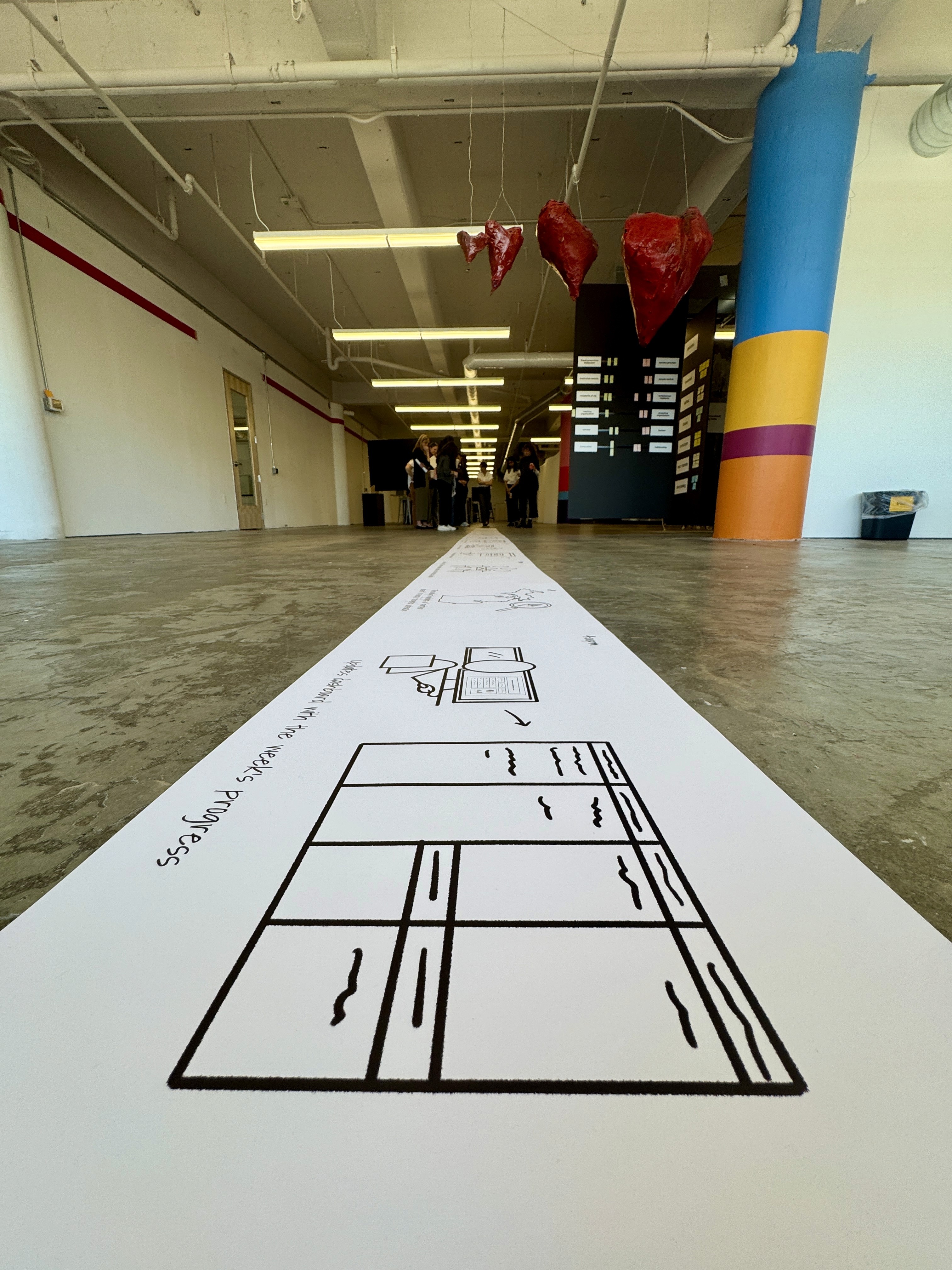
03 · Follow the experience backstage
Then we interrogated what each promise required from UIA.
“Partners can escalate an issue” immediately raised questions about who receives it, what information can be shared, how it gets routed, and who owns the response.
Image: Zoomed journey moment surrounded by operational questions.
04 · Turn experience decisions into organizational decisions
The journey became a tool for designing the program itself.
Together, we translated the experience into staffing, governance, training, communication, measurement, and operational responsibilities.
Strategy
Designing a future you can't build all at once.
How do you create an ambitious statewide program when the resources to build it aren't there yet?
When Phase 2 began in January, expected funding was already gone. The challenge wasn't adapting a finished strategy. It was designing a credible future while being honest about what UIA could support today.
01 · Start with the constraint
We made capacity part of the design conversation from the beginning.
In weekly sessions with UIA leadership and SMEs, we continually tested ideas against the people, infrastructure, relationships, and resources the agency actually had.
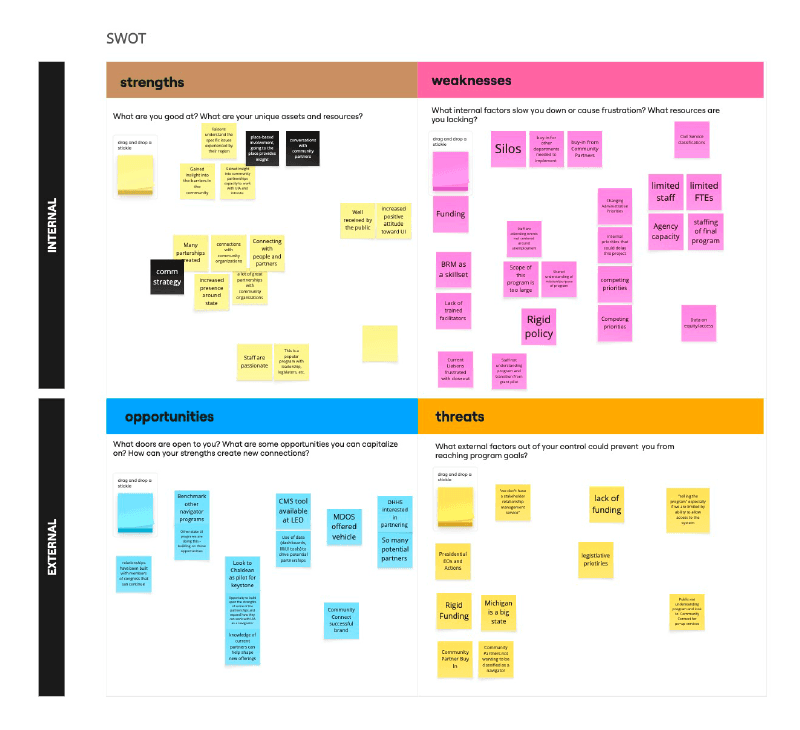
02 · Design the future anyway
Limited resources didn't mean designing only for the present.
Through co-design and future forecasting, we developed a longer-term vision for how partners could be recruited, supported, trained, connected to UIA, and eventually brought into a statewide program.
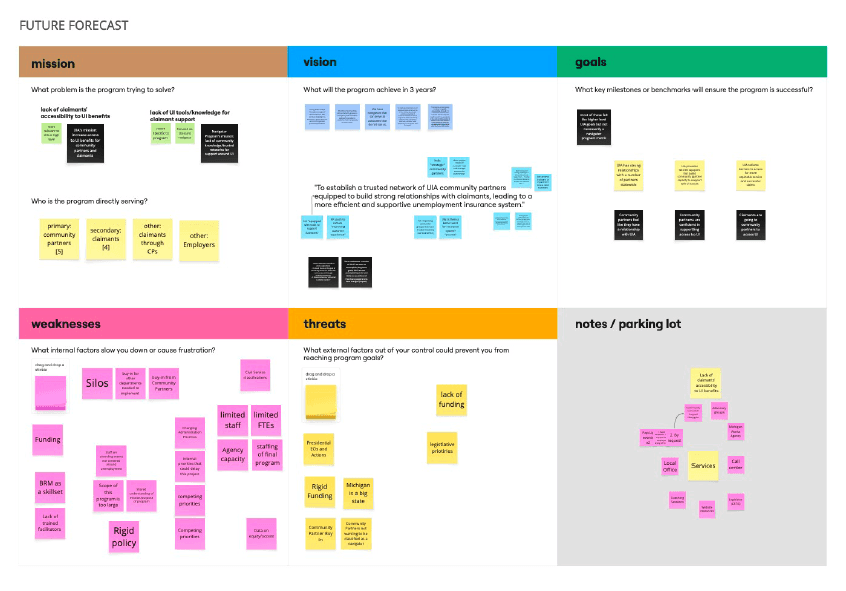
03 · Separate “now” from “next”
Prioritization helped us distinguish what required funding from what required decisions.
We identified actions UIA could take with existing resources, foundational capabilities that needed to be built, and larger pieces that could follow as capacity grew.
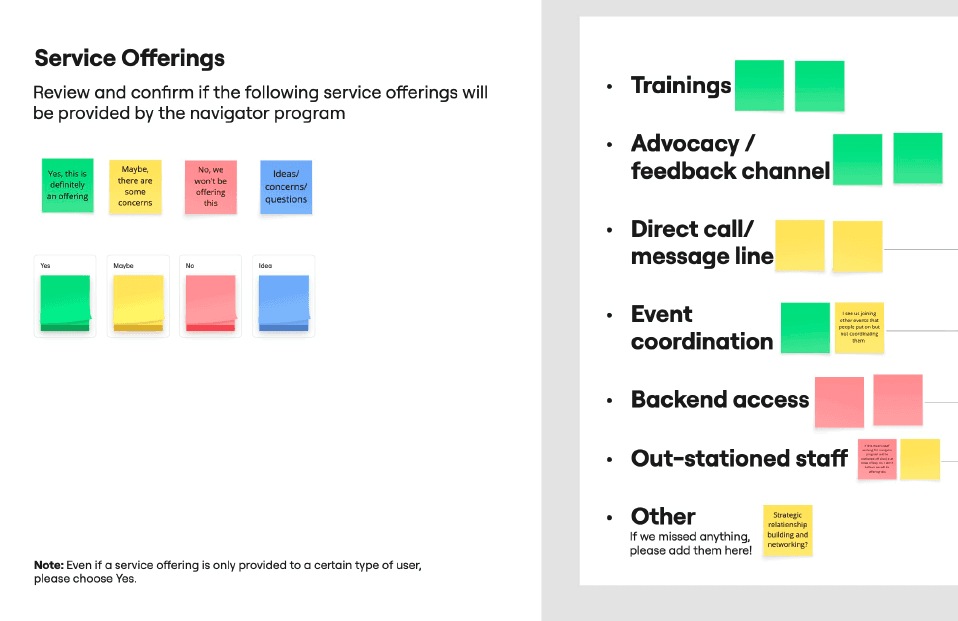
04 · Build a strategy that could grow
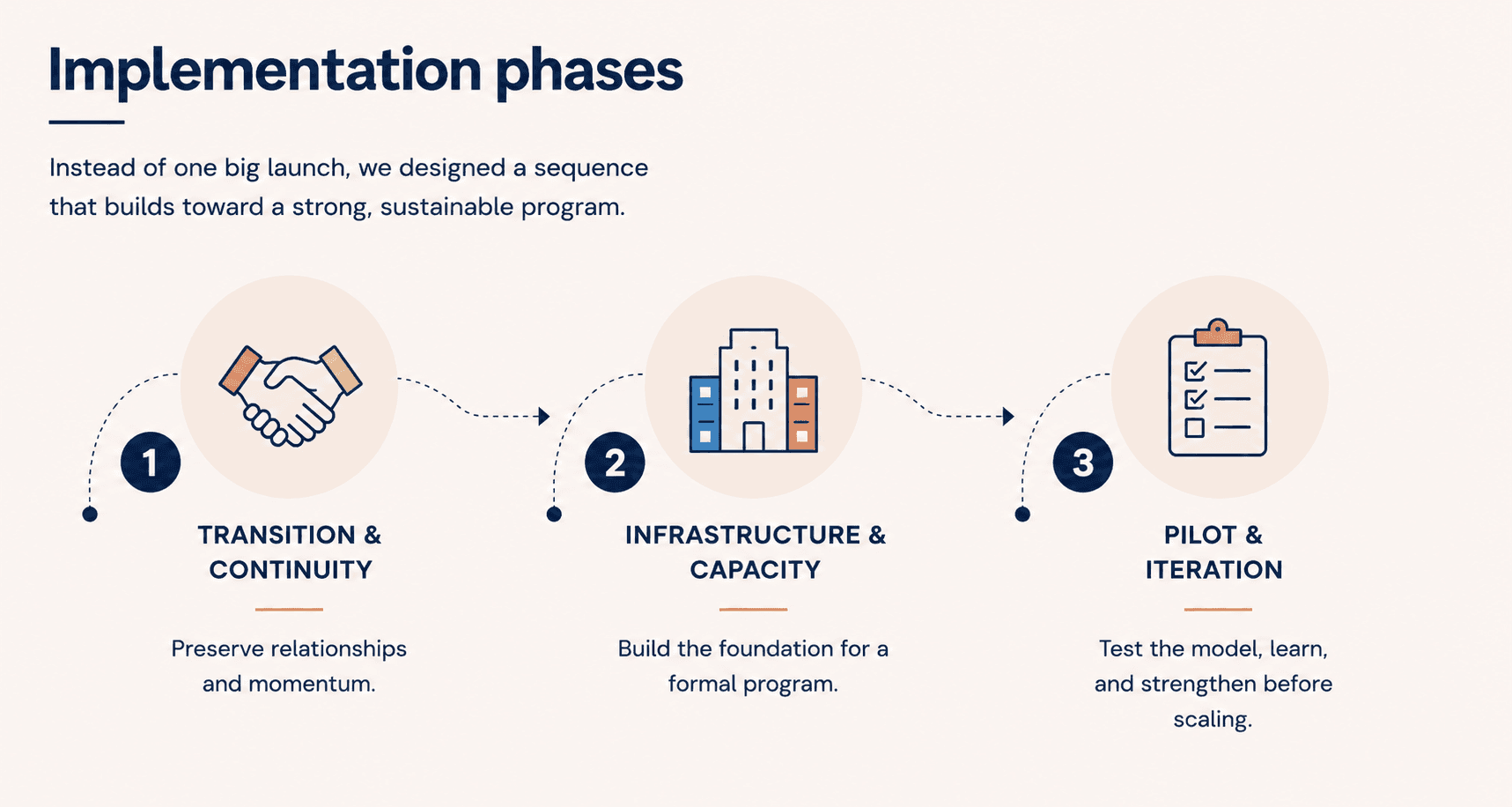
Instead of one big launch, we designed a sequence. Transition & Continuity preserved relationships and momentum. Infrastructure & Capacity built the foundation for a formal program. Pilot & Iteration created a way to test and strengthen the model before scaling.
05 · Leave UIA with a blueprint
The final Strategic Guidance captured both the destination and a realistic path toward it.
It brought together the partner model, service experience, staffing, governance, measurement, and implementation decisions developed through months of facilitated work.

4
Phases of implementation mapped
3
Partner levels defined
40+
Staff and Comunity Partner voices
WHERE IT WENT
The strategy left the room as a plan for action.
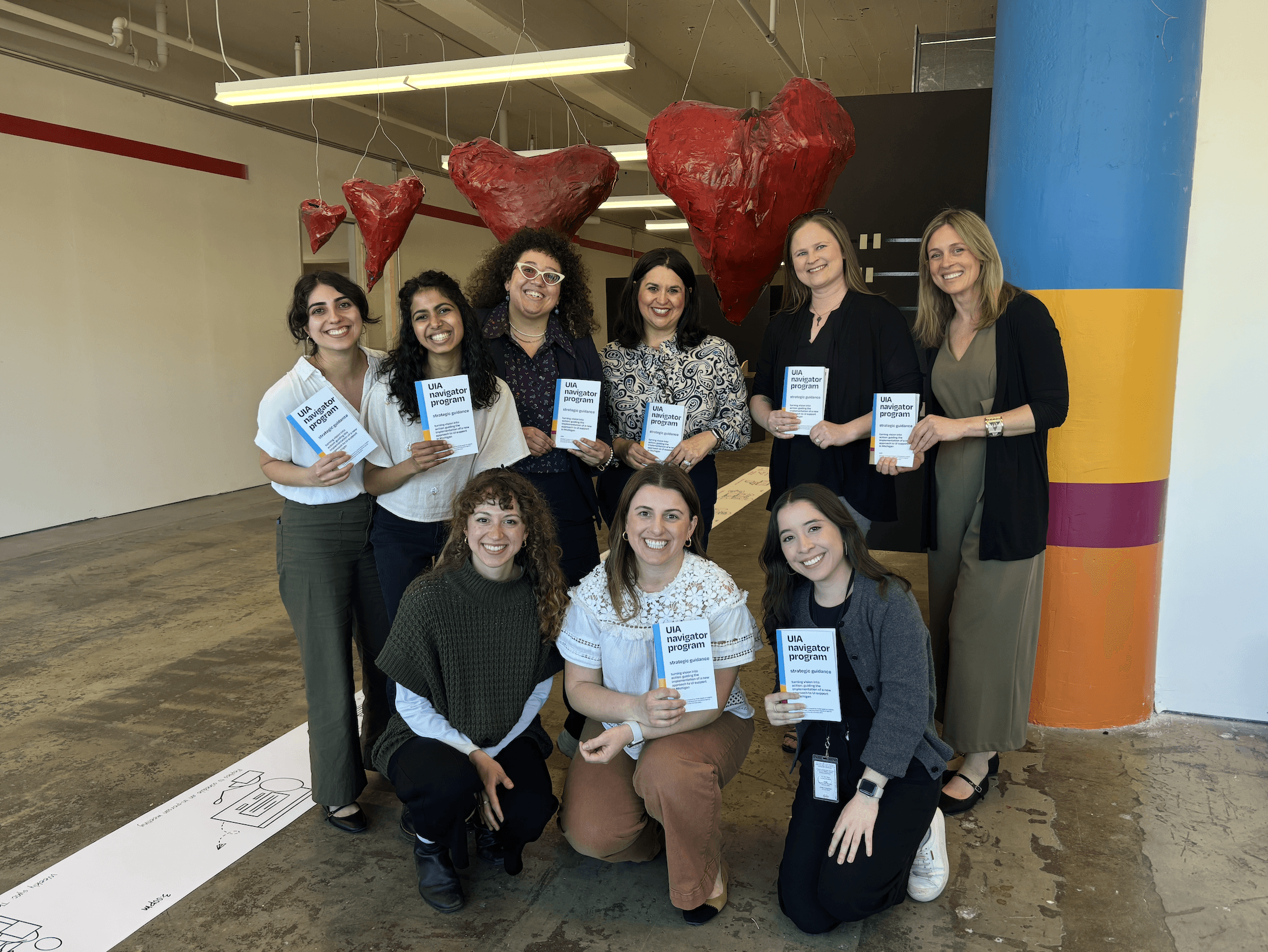
We closed the project with a Design Review with six UIA executive leaders and subject matter experts, walking them through the future-state Navigator Program we had developed together over the previous months.
Rather than presenting a single finished concept, we showed how the pieces connected: the partner model, future-state experience, staffing and governance, implementation phases, and the decisions required to move the program forward.
The future state was well received, and the conversation shifted quickly from “Is this the right direction?” to “What do we need to do next?”
We ended the session with a prioritized backlog of activities, with executive and SME owners identified for work that could begin immediately. Even without the original funding, UIA left with shared alignment around the longer-term vision and concrete steps they could take with the capacity they had.
LOOKING BACK
Project Navigate changed how I think about future-state design.
It's easy to create an ideal experience. The harder question is what has to be true behind the scenes for people to experience it consistently.
A community partner being able to tell someone, “I know who to call at UIA,” sounds simple. Making that promise reliably requires training, staffing, governance, communication, escalation processes, measurement, funding, and relationships someone has to maintain.
The funding shift reinforced another lesson: A good future state gives you direction without requiring the future to cooperate.
The vision needs to be clear enough to align people, but flexible enough to survive changes in funding, policy, leadership, and capacity.
That's what ultimately made Project Navigate useful.