Designing a Better Support System for Unemployment
Organization
Civilla
Client
Michigan Unemployment Insurance Agency
Timeline
December 2024 - May 2025
Role
Design Lead, Research, Service Design & Strategy
What if the people already helping residents navigate unemployment were better connected to the agency behind it?
Across Michigan, community organizations were already helping people understand unemployment, troubleshoot claims, and get unstuck. I led research, service design, and strategy to help UIA turn that informal network into a model for a statewide Community Navigator Program.
Mandate
Define how UIA could work with community organizations to give residents more consistent, trusted unemployment support.
Contribution
Research Strategy · Service Design · Co-Design · Systems Thinking · Program Strategy · Implementation Planning
Outcome
3 partner levels → 1 statewide service model → phased implementation plan
THE SITUATION
People were already getting help. The experience depended on where they went.
Losing a job is stressful enough. Then you're expected to understand eligibility rules, identity verification, online accounts, paperwork, deadlines, and unfamiliar government language.
So people turn to organizations they already trust.
Libraries, workforce organizations, nonprofits, and advocacy groups across Michigan were already helping residents access unemployment services. But their roles, expertise, and relationships with UIA varied widely.
A claimant might find someone who could help resolve a complicated issue, or someone who could only point them back to the website.
The support network already existed. It just wasn't designed as a network.

WHAT I WALKED INTO
The problem wasn't a lack of support. It was the system around it.
A Navigator Program couldn't only work for claimants. It also had to work for the community organizations delivering support and the UIA staff responsible for maintaining those relationships.
That created three connected needs:
Claimants needed somewhere they trusted to get help.
Community partners needed training, clear boundaries, and someone to call when they couldn't solve a problem.
UIA needed a program it could realistically staff, manage, and sustain statewide.
Improving one part meant understanding what the other two needed to make it possible.
We needed to understand what support already existed before designing something new.
We researched how community organizations were already helping claimants, where they felt confident, where they got stuck, and what happened when a problem went beyond their expertise. One finding changed how we framed the entire project.
We started by asking: How do we give community organizations better information?
Research pushed us toward a different question: How do we create a better relationship between UIA and the organizations already helping claimants?
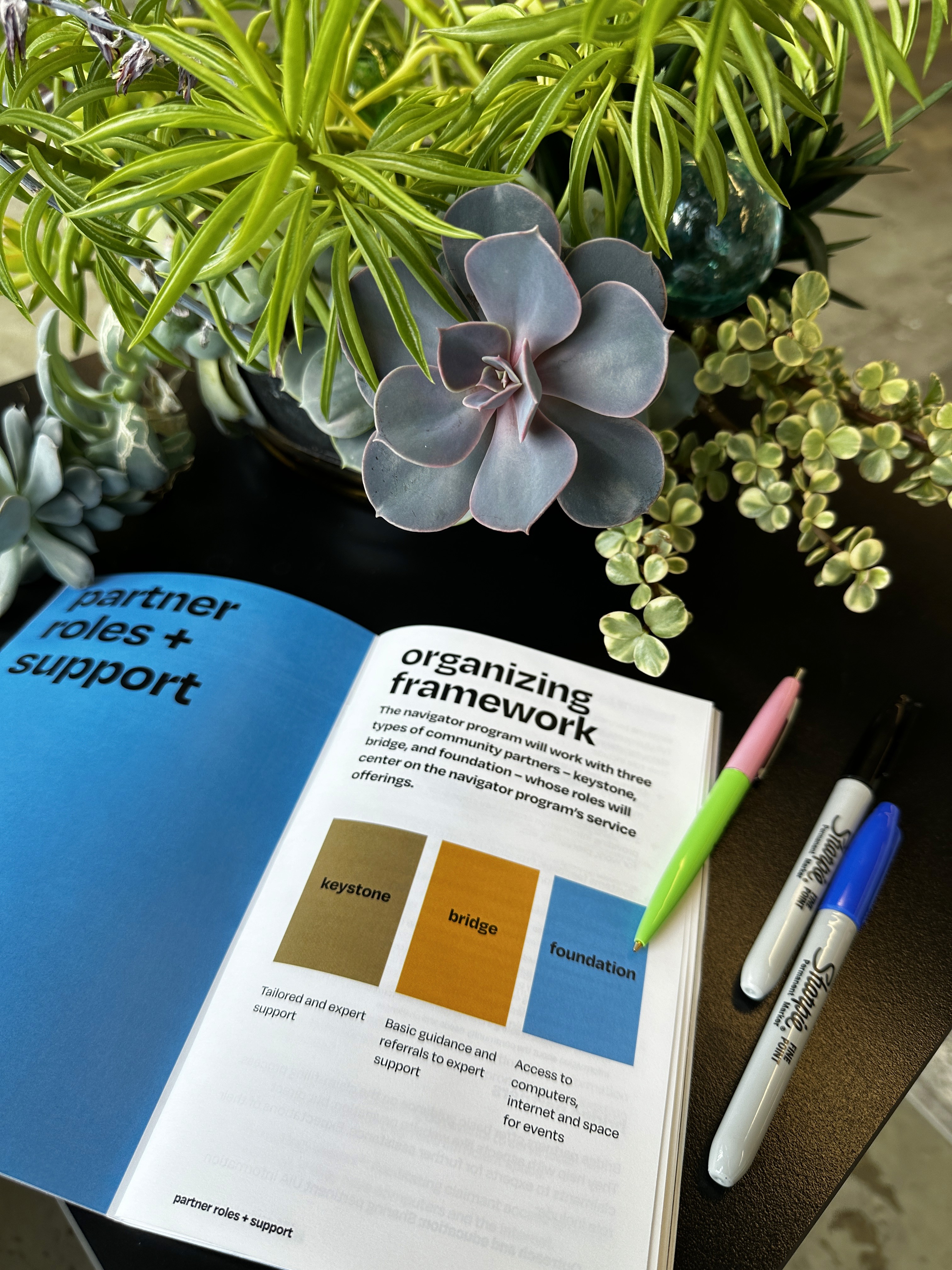
Partners didn't simply need another toolkit. They needed clear roles, different levels of training and support, and a reliable path back to UIA when someone had a problem they couldn't solve.
We weren't designing better resources anymore. We were designing a partnership.

understanding the landscape
We mapped the broader smart-city ecosystem and studied existing transportation and roadway-safety products to understand where Future Roads could fit.
Competitive analysis helped establish the baseline: what tools already enabled, where workflows overlapped, and where connected-vehicle intelligence could offer something meaningfully different.


text
understanding the people
User interviews brought the landscape down to the level of actual decisions.
We explored how transportation professionals identified safety problems, which data they relied on, where their workflows broke down, and how findings ultimately informed planning and investment.
The research revealed that “transportation professional” wasn't one user. People working with the same roadway data had very different responsibilities, levels of technical depth, and reasons for using it.
I helped translate those patterns into personas, organized across two dimensions: class, representing their relationship to the work, and function, representing what they needed to accomplish with the data.


from research to a bet
Four days to decide what was worth testing.
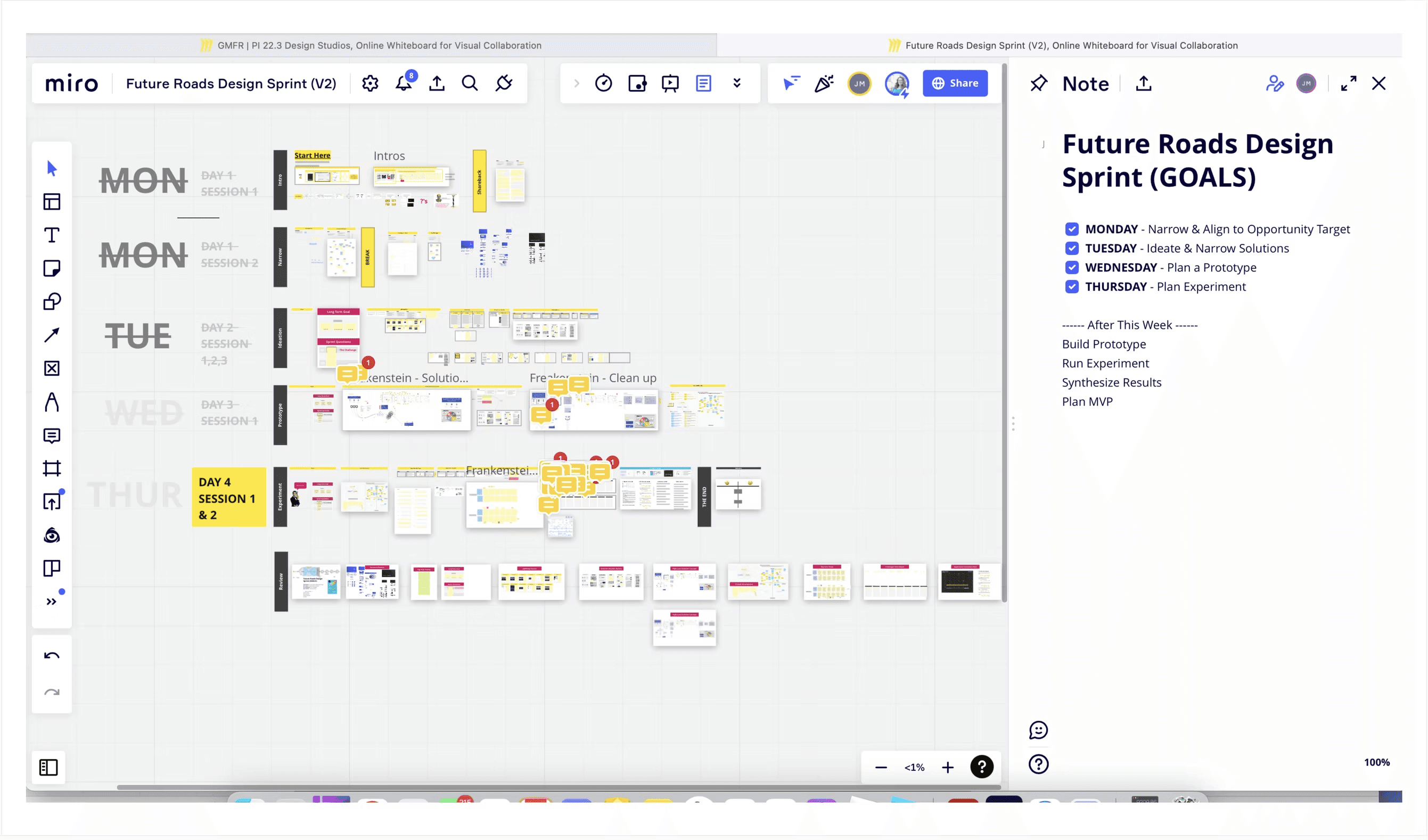
I planned and facilitated a four-day collaborative design sprint to turn what we'd learned into a product direction.
Together, the cross-functional team aligned on the long-term goal for Future Roads, prioritized the most important pain points, explored competing ideas, and converged on a concept we could test with users.
THE SPRINT GAVE US
A NORTH STAR: A shared vision for Future Roads.
A FOCUS: The problems worth solving first.
A BET: A concept concrete enough to test.
Prototype 01
We thought expert users needed high fidelity. We were wrong.
Because we were designing for technical professionals working with sophisticated data, we assumed they'd give better feedback on something that felt close to finished.
So we went high fidelity early.
Users didn't just critique the interface. They challenged assumptions underneath it.
The data often lacked enough context to interpret confidently. Different personas approached the same information with different questions. And some workflows didn't reflect how people actually investigated roadway safety.
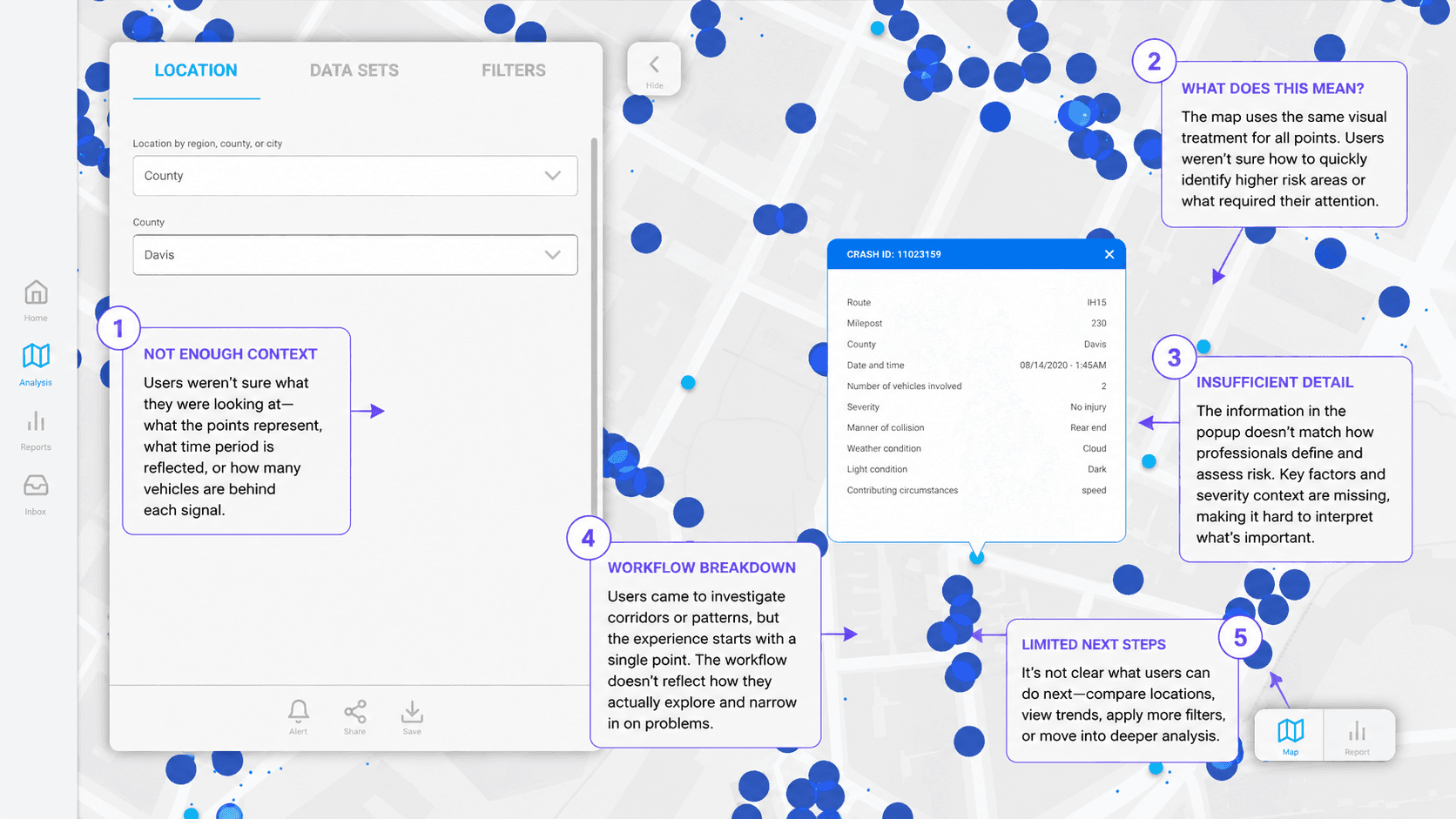
prototype 02
We redesigned around the questions users were actually trying to answer.
Rather than polishing the first prototype, we changed the experience based on what we'd learned and tested it again.
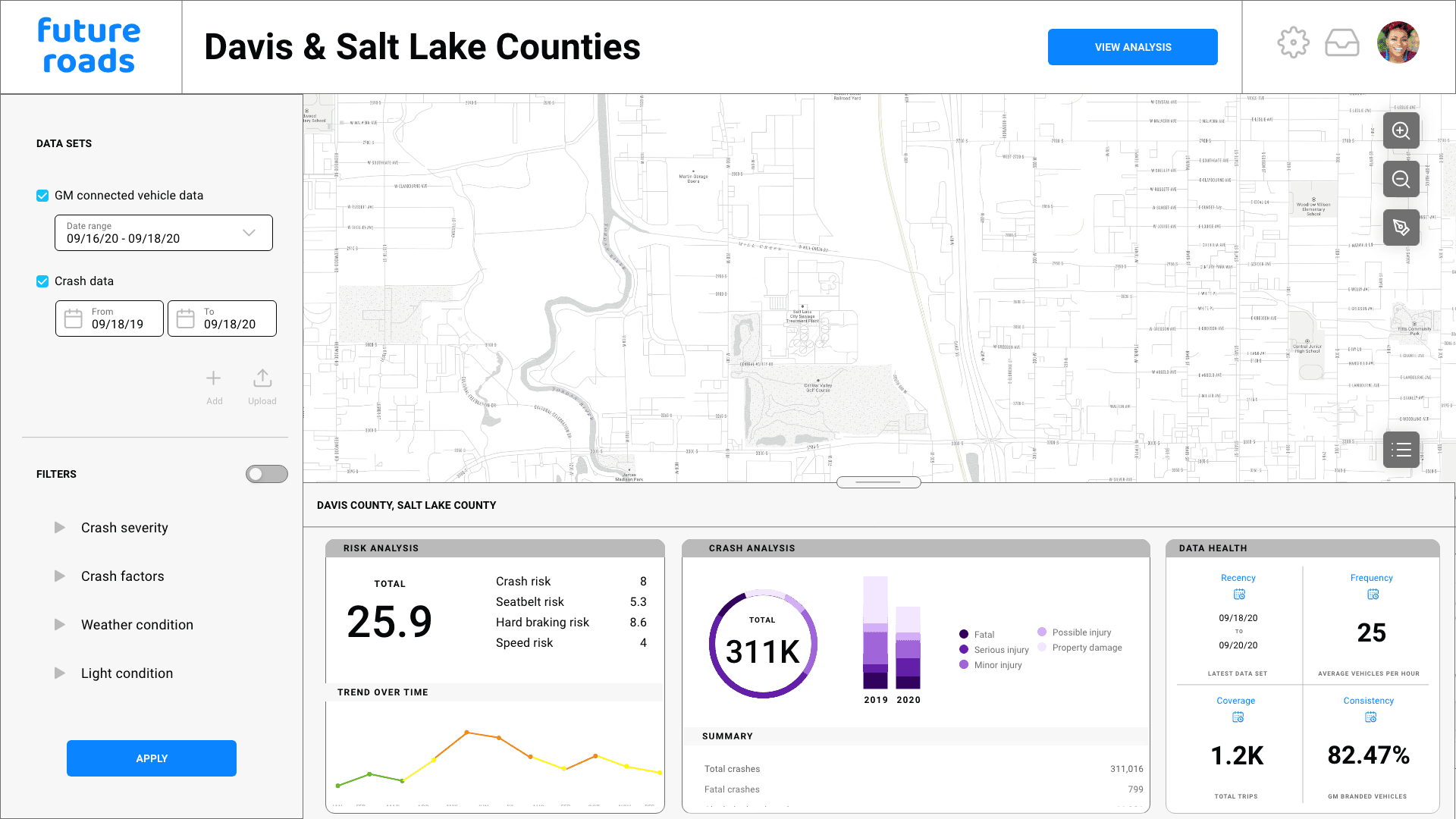
The second round surfaced three important tensions:
01 / More data didn't create more confidence.
Users needed context to understand what a metric represented and what they could reasonably conclude from it.
02 / Leadership and practitioners didn't always define value the same way.
UDOT leadership placed less emphasis on integration and workflow enablement than practitioners, who saw them as important to their day-to-day work.
03 / We supported investigation better than discovery.
Future Roads was increasingly useful when someone already knew where to look. But what if the product could help surface the roads that deserved attention in the first place?
what the research changed
We stopped thinking about Future Roads as one big dashboard.
Discovery, the design sprint, and two rounds of testing gave us a much clearer product direction.
Future Roads needed to support different users and modes of analysis, provide enough context to make complex data trustworthy, and let people move from broad signals into deeper evidence without overwhelming them.
Those findings became the foundation for the MVP I helped define next.

DEFINING THE SUPPORT SYSTEM
Designing the future with the people who would have to make it work
By the time we moved from research into design, the conditions around the program had changed.
Following the election, expected funding for the Navigator Program was no longer available. When Phase 2 began in January, we weren't designing a fully funded program and then figuring out how to scale it back. We were designing within that constraint from the start.
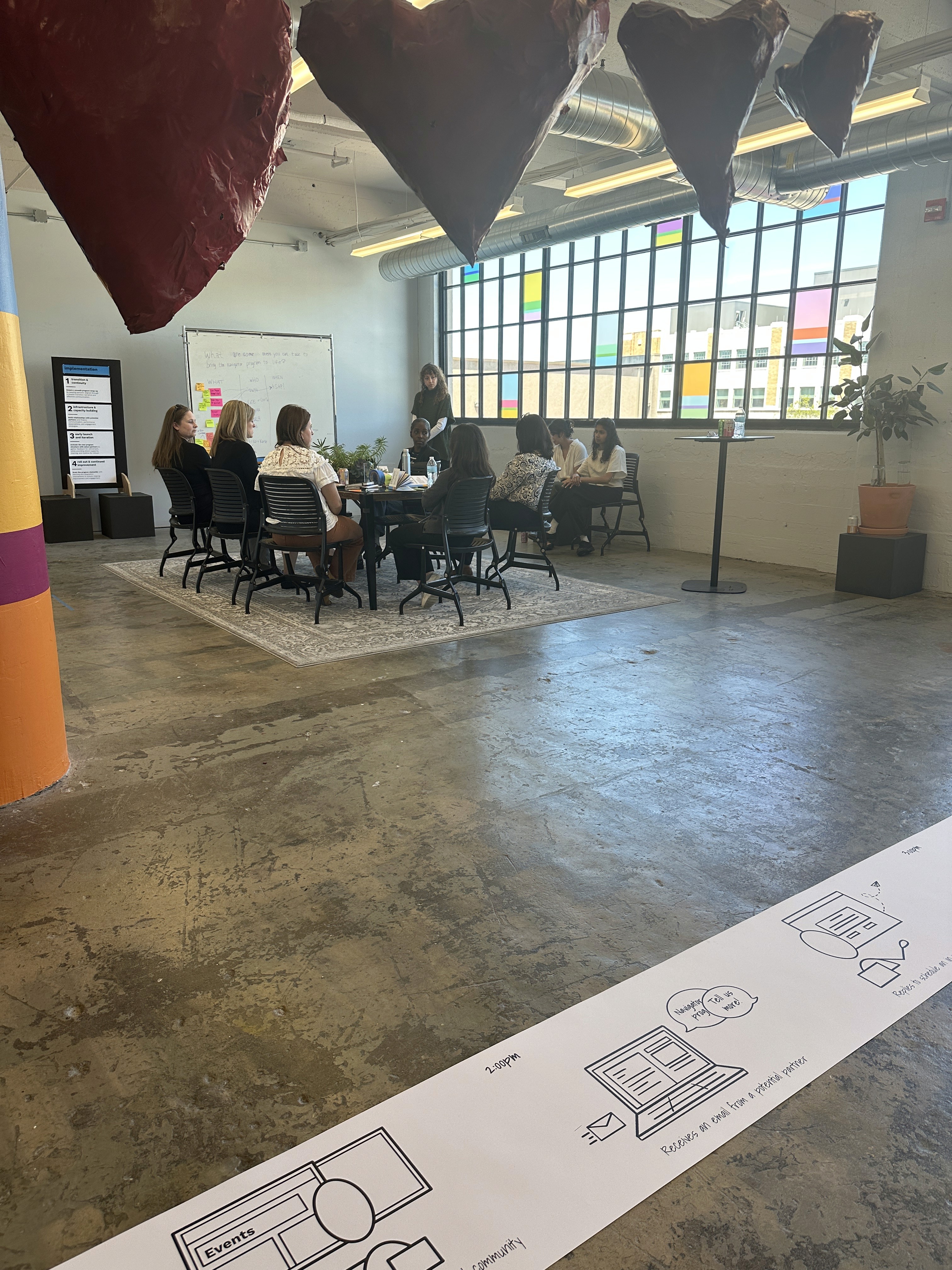
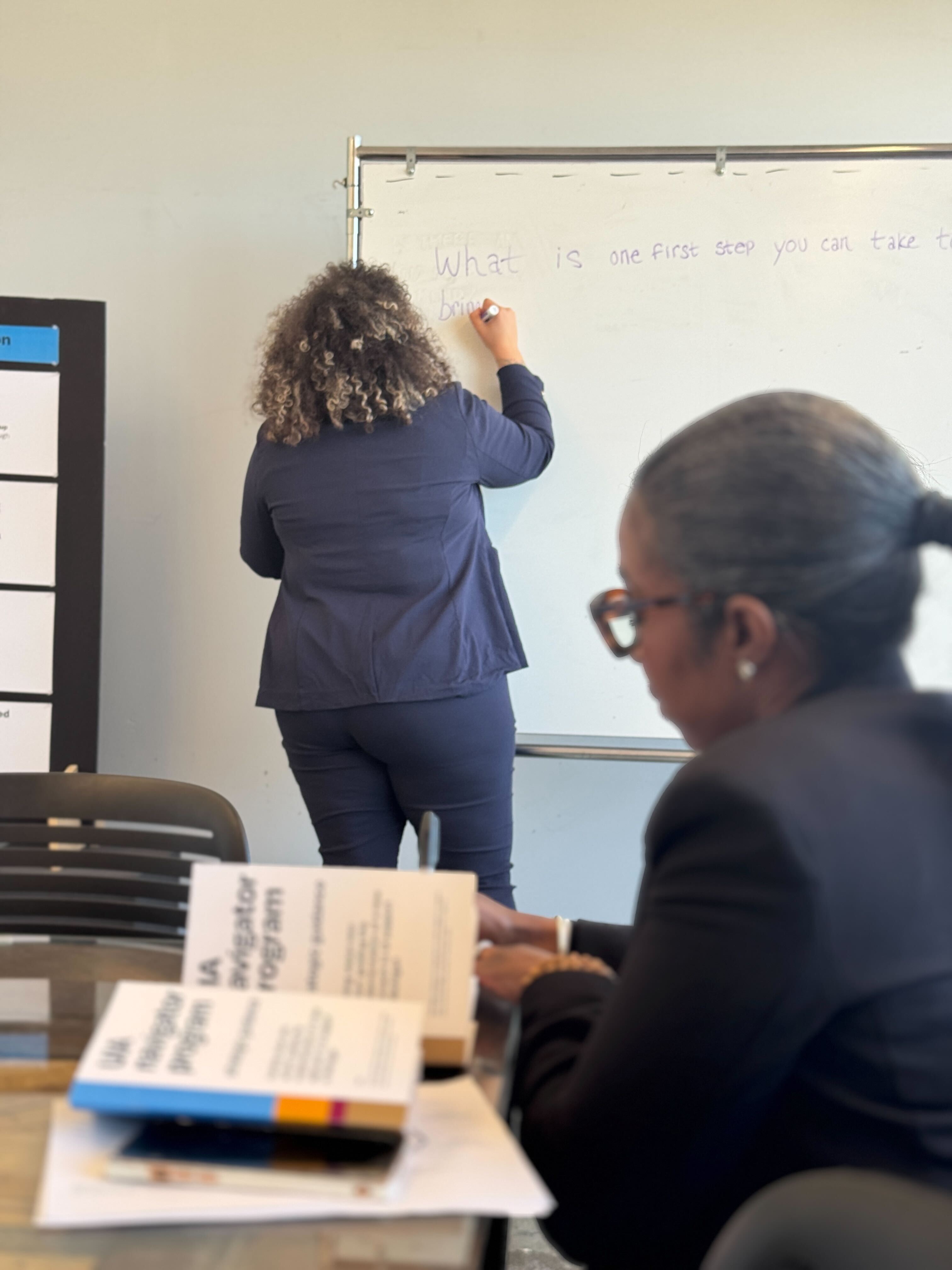
Our design process became a series of weekly facilitated working sessions with UIA leadership and subject matter experts. Rather than bringing the agency a finished recommendation, we used each session to work through a different part of the program together.
We used co-design, card sorting, prioritization, SWOT analysis, and future forecasting to explore questions like:
What kinds of organizations should participate?
What should partners actually be responsible for?
What support could UIA realistically provide?
What would need to happen inside the agency?
What could begin with existing resources?
What should the program grow into over time?
Each week built on the last, gradually turning the research into a program UIA could actually operate.
Suggested image: A horizontal January → May timeline with 4–6 actual facilitated sessions and small artifact thumbnails underneath. This should become the primary Design Process visual.
01 / define the mvp
We had plenty of ideas. The harder question was what earned a place in version one.
I worked with Product, Data Science, Engineering, and Design to translate what we'd learned through research and prototype testing into a focused MVP.
We used story mapping to lay out the end-to-end experience, connect user needs to potential capabilities, and make the tradeoffs visible.
Together, we identified the tasks that were essential to the core experience, prioritized the features that delivered the most value, and pushed everything else beyond the first release.
This gave the team more than a feature list. It created a shared definition of what Future Roads needed to accomplish first.

02 / map the experience
The MVP told us what to build. User flows defined how it needed to work.
I translated the prioritized stories into end-to-end user flows, mapping how transportation professionals would move between the core tasks in the MVP.
That meant working through questions like: Where does someone enter the experience? How do they select a location or dataset? How do they move from a broad signal into deeper analysis? What happens when they change their question? And how do different workflows connect without forcing someone to start over?
The flows gave Product, Design, Data Science, and Engineering a shared model of the experience before we committed to individual screens.

03 / make it buildable
Low-fidelity design let us define the experience while engineering started underneath it.
With the MVP and core flows established, I moved into low-fidelity sketches and wireframes.
At this stage, the goal wasn't visual polish. It was giving enough definition to navigation, hierarchy, interactions, filters, data relationships, and system states that we could make decisions quickly and engineering could begin building the underlying infrastructure.
The wireframes became a bridge between the product vision and implementation, giving the team something concrete to discuss while keeping the interface flexible enough to change.


04 / build the visual system in parallel
While engineering built the foundation, I built the system the interface would need.
Once engineering had enough definition to begin backend development, I could work in parallel on the visual layer of Future Roads.
I developed the Future Roads brand and product identity, giving the emerging platform a visual language that could extend across the interface, prototypes, presentations, and other touchpoints.
At the same time, I created a reusable UI component library aligned with the U.S. Web Design System (USWDS). Instead of designing each screen independently, I established shared patterns for navigation, filters, inputs, cards, tables, controls, states, and other recurring interactions.
That gave us two things we hadn't had before: a recognizable product identity and a reusable set of rules for turning the wireframes into production-ready UI.


05 / turn the MVP into connected workspaces
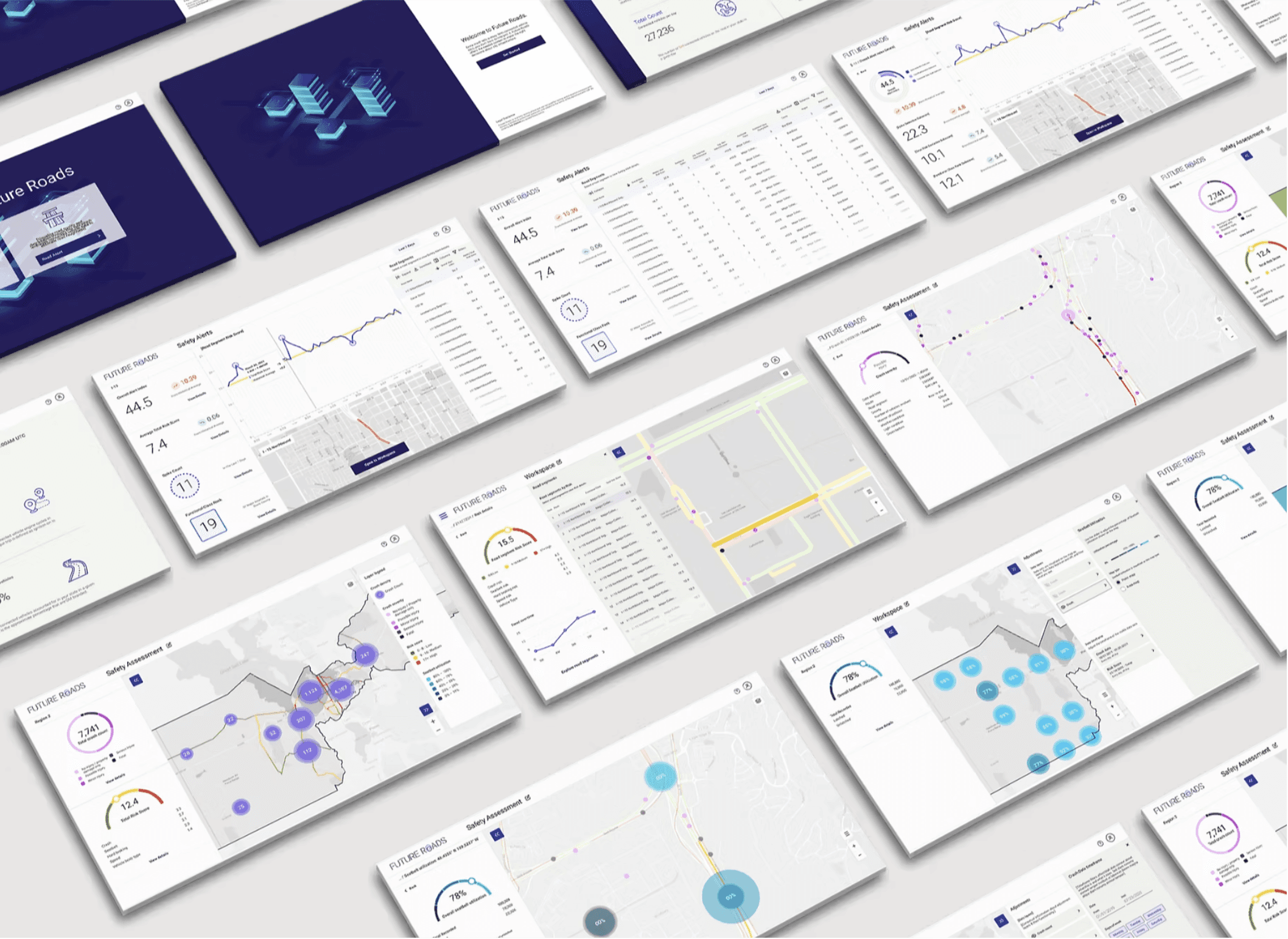
The product wasn't one dashboard. It was a set of tools for different kinds of work.
With the MVP defined, the backend taking shape, and a visual system in place, I moved into detailed interface design.
The research had shown that transportation professionals weren't performing one linear task. They moved between different modes of work: exploring broadly, investigating a particular question, examining detailed evidence, and preparing information for decisions.
I translated those needs into connected workspaces, each optimized for a different job while sharing the same underlying navigation, interaction patterns, and component system.
Safety alerts: Know where to look first.
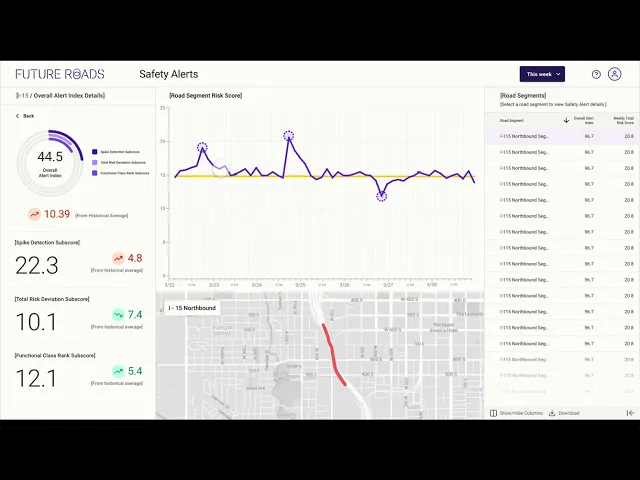
Safety Alerts shifted the experience from requiring users to already know where a problem existed toward proactively surfacing areas that might need attention. Risk signals and high-risk road segments gave transportation professionals a starting point, with the ability to move from an alert into deeper analysis. The MVP included road-risk modeling and high-risk segment analysis and ranking, while custom alerts and notifications were planned as a post-MVP capability.
Discovery: Dig into what's happening and why.
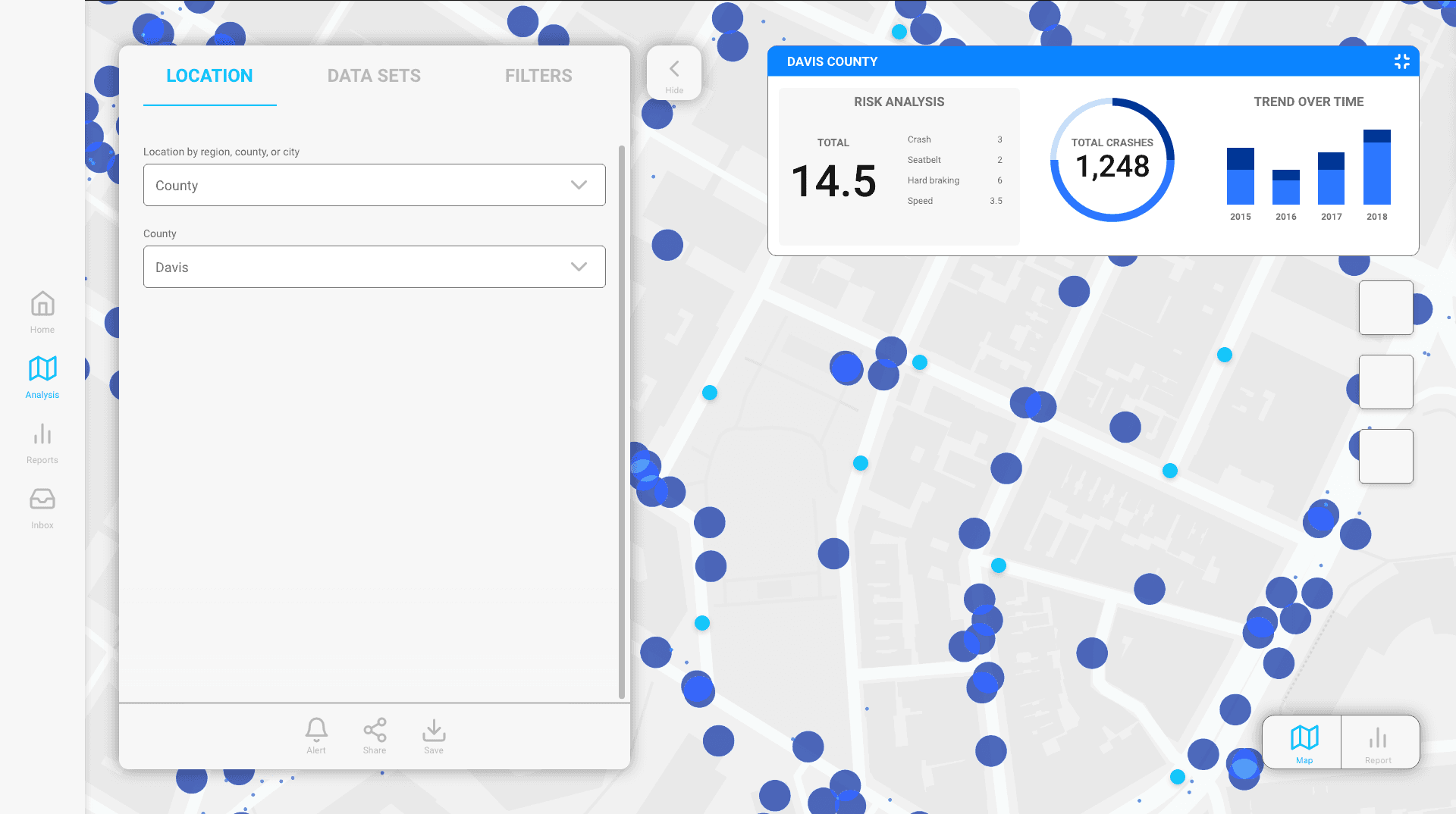
Discovery gave users a flexible workspace for investigating a location or safety question in more detail. Users could query by location, explore crashes spatially on the map, review summary and individual crash data, and narrow the analysis by factors like severity, collision type, weather, lighting, crash factors, and time.
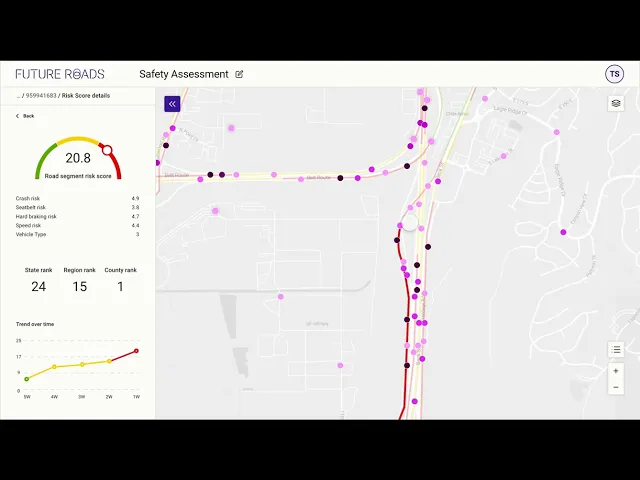
Together, the workspaces supported a more connected workflow: find where attention may be needed, then move into the evidence to understand why.
06 / launch the beta product
the launch was another experiment, not the finish line.
Future Roads launched as a live customer pilot with the Utah Department of Transportation, giving us the opportunity to see how the product performed in a real transportation environment.
We intentionally masked the GM brand so the experience could stand on its own, keeping the focus on the product's core functionality and unique value for transportation professionals.
Rather than treating beta as a finished product, we used the pilot to keep building, testing, and learning as we worked toward problem-solution fit.
4
Phases of implementation mapped
3
Partner levels defined
40+
Staff and Comunity Partner voices
WHERE IT WENT
The strategy left the room as a plan for action.
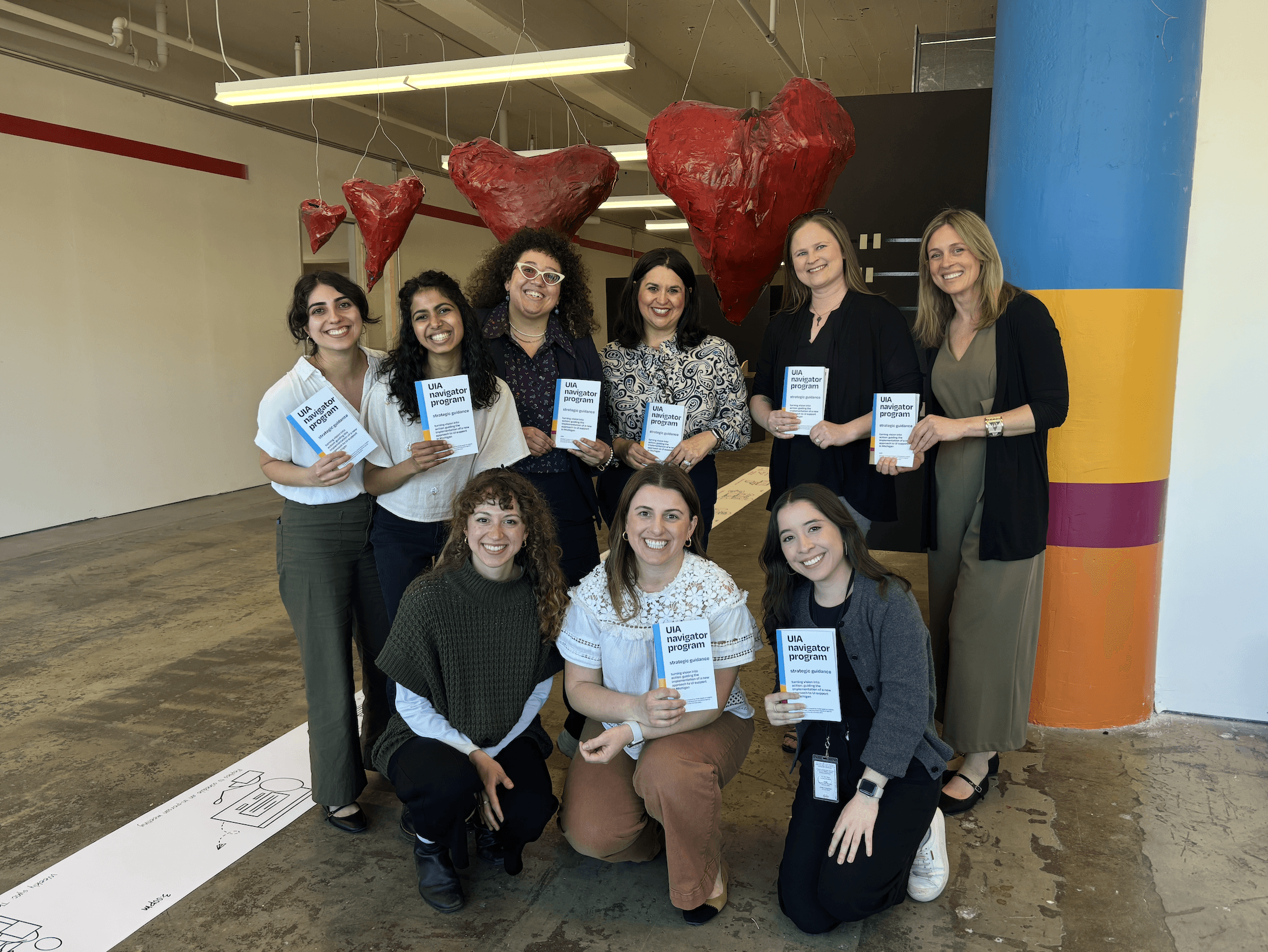
We closed the project with a Design Review with six UIA executive leaders and subject matter experts, walking them through the future-state Navigator Program we had developed together over the previous months.
Rather than presenting a single finished concept, we showed how the pieces connected: the partner model, future-state experience, staffing and governance, implementation phases, and the decisions required to move the program forward.
The future state was well received, and the conversation shifted quickly from “Is this the right direction?” to “What do we need to do next?”
We ended the session with a prioritized backlog of activities, with executive and SME owners identified for work that could begin immediately. Even without the original funding, UIA left with shared alignment around the longer-term vision and concrete steps they could take with the capacity they had.
LOOKING BACK
A future state only matters if the system behind it can deliver it.
Project Navigate changed how I think about future-state design.
It's easy to create an ideal experience. The harder question is what has to be true behind the scenes for people to experience it consistently.
A community partner being able to tell someone, “I know who to call at UIA,” sounds simple. Making that promise reliably requires training, staffing, governance, communication, escalation processes, measurement, funding, and relationships someone has to maintain.
The funding shift reinforced another lesson: A good future state gives you direction without requiring the future to cooperate.
The vision needs to be clear enough to align people, but flexible enough to survive changes in funding, policy, leadership, and capacity.
That's what ultimately made Project Navigate useful.